We know, that we are in a crisis and we know why. In theory, we also know how to stop it. But there are still many questions that remain unanswered. That’s why we organised a seminar series during ETH lunch breaks to discuss these topics with invited speakers, students and academic staff. Thank you for everyone that joined in the fruitful discussions and special thank you to all the speakers that prepared such amazing talks, were open and approachable for questions. Here are my learnings:
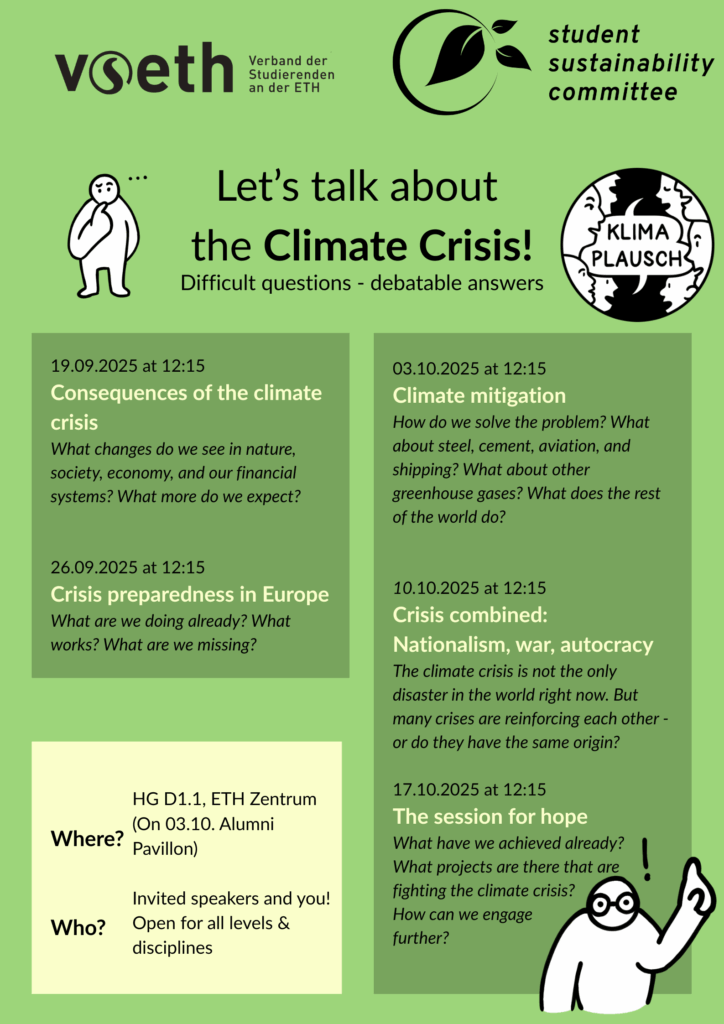
1st session: 19.09.2025 at 12:15
Consequences of the climate crisis: What changes do we see or expect in nature, society and economy?
Thank you to Dr. Petra Sieber, Lisa Buchmann and Dr. Bianca Biess
In the first session we developed a feeling of the dimension of the climate crisis. Dr. Petra Sieber explained how climate impacts show a high temporal and spatial variability with Europe being a hot-spot of warming. A challenge for adaptation is that a wide range of climate related challenges occur at the same time like an increase of average temperatures, heat-waves and flooding. Using several examples, we understood how this affects biodiversity and ecosystems, human health and well-being and business and economy all at the same time.
We focused on human displacement as one impact, as Lisa Bachmann presented her Master Thesis. We learned that low socio-economic development and a weak government structure means that people are less able to prevent damage or to recover from it and people will be displaced earlier. Whether people return to their homes after the impact depends on the land owning structure. This emphasizes that in order to protect communities, it is important to bridge the knowledge of the climate-related risks and the communities‘ capabilities to deal with the risk.
e learned about examples of droughts and floods occuring
- Physical gradual impacts: heat waves, extreme events, droughts, floods, fires
- Tipping points: forest die backs, AMOC
- Societal impacts: climate displacement, climate migration patterns, food insecurity, water shortage
- Economical impacts: limits of insurability, financial crisis through uncertainty
2nd session: 26.09.2025 at 12:15
Crisis preparedness in Europe: what works, what are we doing, what are we missing?
- City-level preparedness: What measures can we take to protect people in cities (sponge city against flooding, trees in cities against heat, climate-smart buildings)?
- early warning systems
- climate adaptation in the agricultural sector: resilient crops, crop insurance
- resilience of the energy sector: hydropower in decadal drought, cooling systems for nuclear energy
3rd session: 03.10.2025 at 12:15
Climate mitigation: How do we solve the problem? Which parts do we not know how to solve?
- Overview: How do we decarbonise in different sectors (Energy, agriculture and food systems)?
- Hard to abate sectors: Which ideas are around to decarbonise steel and cement industry, aviation, shipping? What do we know about how well they work?
- Other greenhouse gasses: where do we stand with CH4 and N2O emissions?
- International perspective: How do European emissions, technology and ideas compare with other countries and how is the world developing in those aspects outside our European bubble?
- Money: What industries do we finance right now, where do we need more money and how do we leverage more money for the right projects?
4th session 10.10.2025 at 12:15
Crisis combined: The climate crisis is not the only disaster in the world right now. But many crisis are reinforcing each other – or maybe they have the same origin?
- Nationalism: Is the increased nationalism a result of climate impacts, climate migration and the fear of the future or a result of a shift in economy and social values caused by climate mitigation measures?
- War and autocracy: Do climate impacts increase the shift towards autocracies? How much carbon emissions are caused by war? How much do autocracies emit vs democracies?
- Capitalism: the cause of all evil?
5th session 17.10.2025 at 12:15
The session for hope: What have we achieved already? What projects are there, that are fighting the climate crisis? How can we further engage?